
Did you know that obesity is the most common nutritional disorder seen in our canine and feline friends? Over 40% of Australian pets are overweight!
Just like us, excess fat in animals can pose some serious health concerns – ultimately reducing your pet’s life expectancy.
You probably know that we check your pet’s weight and make recommendations about weight loss and nutrition as part of your pet’s regular check-up, but did you know you can easily evaluate your pet’s body condition at home between visits?
A Body Condition Score (BCS) is a number assigned to your pet based on evaluation of fat at a few key areas on their body. A BCS can range from 1 to 5, with 1 being severely underweight and 5 being dangerously overweight.
What to look for: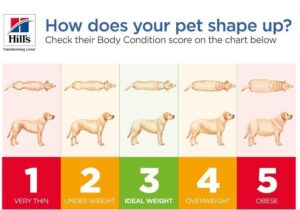
It is important to assess your pet’s silhouette from above AND from the side – evaluating the ribs, spine, hip bones, waist, abdomen, muscle mass and overall fat covering. At an ideal weight you should be able to see your pet’s waistline (an hourglass figure when standing above). When viewing your pet from the side your pet’s abdomen should be tucked up behind the rib cage.
It’s also critical that you feel your pet to evaluate their weight. Place your thumbs on their backbone, spreading both hands across the ribcage. You should be able to feel each rib under a thin layer of fat – just like you can feel the bones on the back of your hand.
If you’d like us to show you how, ask us next time you’re here – or book a FREE WEIGHT MANAGEMENT CONSULT.