
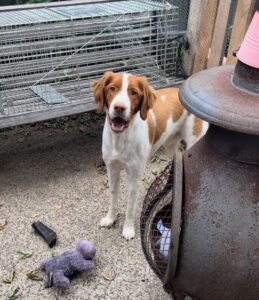
Lovely Oscar, the gorgeous 3 year old Brittany Spaniel, recently visited Dr. Susi at the Narre Warren clinic with a very odd problem. His owners had noted that the previous evening, Oscar suddenly had difficulty closing his mouth and was drooling quite a bit. He couldn’t seem to chew anything, but was just managing to eat and drink, though it was a very messy affair!
These symptoms can be indicative of many different disease processes, trauma, or neuropathy (nerve damage), so Dr. Susi certainly had her work cut out for her. Treatment began tentatively for Oscar with some anti-inflammatories and an antihistamine, with his owners being advised to go straight to emergency if Oscar deteriorated once home. If there was no improvement over the weekend, then further tests would need to be performed.
Unfortunately, there was no improvement at all, and Oscar’s “dropped jaw” persisted. His owners were needing to feed his food in “meatballs” just to ensure he could eat, and drinking water was certainly a challenge for him. Dr. Susi’s first suspicion was that of idiopathic trigeminal neuropathy, which is where the cranial nerves that are primarily responsible for jaw movement and sensation of the face are affected on both sides of the head. Its typical presentation was very similar to Oscar’s with a sudden loss of jaw function, and it is the most common neurological cause of an inability to close the mouth. There is no specific treatment for idiopathic trigeminal neuropathy, but intensive nursing on behalf of the owners is certainly required at home, as dogs are generally unable to eat or drink without assistance. The prognosis is generally very good, with most dogs recovering the ability to close their jaw within two to four weeks.
However, the diagnosis of idiopathic trigeminal neuropathy is determined by a process of elimination, meaning that the diagnosis is made by ruling out other diseases that might cause the same or similar clinical signs. Other neurological causes of an inability to close the jaw include infection, inflammation, cancer, or trauma to the trigeminal nerves. Other causes of “dropped jaw” also include trauma such as luxation of the jaw joint (when it pops out of place), fractures of the jaw, and also foreign bodies affecting the mouth and jaw. These causes can be eliminated by examination of the oral cavity under sedation or general anaesthesia, blood tests that include an infectious disease panel such as the one run on Oscar, advanced imaging such as CT or and MRI, or a cerebrospinal fluid (CSF) analysis being performed.
With so many possibilities, and many of them being far more sinister than what she suspected, Dr. Susi made sure that all suitable tests were starting to be run, and advice was sought from specialists to make sure that nothing was missed in helping Oscar to get the help he needed. A couple of weeks later, after a visit to the neurology department at the specialist hospital and some improvement at home, (with his blood test coming back normal for any infectious disease processes), all his results seemed to support Oscar’s initial diagnosis of idiopathic trigeminal neuropathy. Dr. Susi was still cautious however, letting the owners know to keep a very close eye on Oscar, and that if there were any changes, or his dropped jaw got worse again or reoccurred later (which is rare in these cases), that they seek further imaging and management by a specialist.